The Phoenix · https://thephoenix.news/features/micky-quinn-records-highbury-heroics-and-the-england-call-that-never-came-131761
Micky Quinn: Records, Highbury heroics and the England call that never came

12.10.26, 07:16 Updated 12.10.26, 09:55 7 Minute Read
We’re heading into the winter of 1992/93 and Bobby Gould is on the lookout for a striker for his Coventry City side.
Gould’s Sky Blues had made a decent start to the season, but he saw that they were lacking a finisher in the box. He delved into his little black book of names (yes, this was a real little black book) and picked out a name from the league below.
In November 1992, Micky Quinn was 30 years old. He had been prolific in the previous three years for Newcastle, scoring 63 goals in 131 appearances as the Magpies tried to gain promotion to the top flight.
‘I scored 39 goals [in 1989/90 for Newcastle], 34 in the league,’ Quinn tells The Phoenix. ‘Mark McGhee scored 26 goals. We scored 60-odd goals between us and still couldn’t get automatic promotion.
‘We finished third and we played against West Ham in a game where we had to win just to get in the play-offs. It was ridiculous. We had games like beating Leicester 5-4. We were conceding goals left, right and centre. That was one of my biggest disappointments, not getting promotion that season.’
Newcastle would fail to win promotion in any of Quinn’s three full seasons at the club. Early in his fourth season, he found himself out of favour at St James’ Park and was on his way to Coventry. Gould was clear about what he wanted from Quinn – someone who would get into the box and stay there.
It was music to Quinn’s ears.
‘My move to Coventry came from a chat with Bobby where he said that they had a decent team but they just couldn’t finish,’ Quinn recalls. ‘He wanted me to come in and score the goals.
‘He didn’t want me to come back for corners, he didn’t want me to come back for free-kicks, he just wanted me to reserve my energy for being in the box. It was what every striker wanted to hear.’
Quinn arrived at Highfield Road and liked what he saw.
‘It was an eclectic mix in that dressing room. You had Kenny Sansom at left-back, you had guys like Oggy, Borrows and Micky Gynn from the FA Cup team. It wasn’t a bad squad. Kevin Gallacher was there when I arrived.
‘Nuddy was exciting. I watched a couple of games when I joined and saw that they had been creating chances. I just wanted to hit the ground running and score some goals.’
There was just one problem. Quinn, a man no stranger to a wager, had taken out a pre-season bet on the Sky Blues to be relegated from the Premier League. It was a situation that raised plenty of laughs from Gould and Quinn but the latter’s performances on the pitch soon showed that he was more than happy to lose his bet.
Record breaker
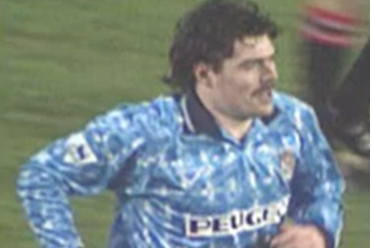
Quinn, who affectionately became known as Sumo at Highfield Road due to his less-than-athletic shape, banged in the goals from the moment he arrived. He started with a brace in a 3-2 defeat to Manchester City. He then scored in draws against Sheffield United and Ipswich before another brace against Southampton in a 2-2 draw.
Six goals in his opening four matches in sky blue – but his new club didn’t have a single win to show for it.
‘I got off to a good start and scored goals even if the results weren’t always going for us,’ he says. ‘I didn’t realise what a great start I would get off to. I was rattling in the goals. I was setting records.
‘The Premier League was still in an embryonic stage but I was the quickest player to five Premier League goals, in three games.’
The records kept on tumbling. Quinn scored four in his next two matches and finally bagged his first win as a Coventry player – and what a way to do it.
The Sky Blues thrashed Liverpool 5-1 on 18 December and then humbled Villa in a 3-0 Boxing Day win. It took Quinn’s tally to ten goals in six matches. That was a Premier League record and one that stood for three decades.
‘I was the quickest player to ten Premier League goals, in six games,’ Quinn beams. ‘Years later, you look at the list of players below me for those records and you have Sergio Agüero and Diego Costa, who scored nine goals in six games.
‘I scored in my first six Premier League games, which was a record, and that record stood for 30 years.
‘Look at all of the world-class players who came to the Premier League who couldn’t beat those records. And then old big b******s came in, Erling Haaland.
‘I’m not one of those players who says that records are there to be broken. I didn’t want them to be broken!
‘Those records lasted 30 years, so why not let them last a bit longer! He came in and broke the records except the one for scoring in the first six Premier League games from your debut. He didn’t score in his third game against Bournemouth. So, I think that record of mine still stands.’
Quinn managed 14 Premier League goals in his first 13 matches for Coventry. As late as March, the Sky Blues were fifth in the table. However, the sale of Quinn’s strike partner Robert Rosario to Nottingham Forest for £450,000 unsettled the team.
Quinn would score just three goals in his final 14 matches of the season following Rosario’s departure. Coventry slipped from fifth in March to 15th by the end of the season.
Today, Quinn is adamant that the sale of Rosario killed the campaign.
‘At Coventry, it all changed when they sold Roberto Rosario,’ he says. ‘That was the chairman at the time. They sold him for just about a round of drinks.
‘We were a great partnership on and off the field. Selling him was hugely disappointing. You look at the impact that he had. He was mobile for a big fella and was involved in just about every goal. Gouldy didn’t want to sell him.’
Gunning down the Gunners
Despite the loss of Rosario, Quinn started the next season on fire. Following the infamous pre-season trip to Aldershot army barracks, Quinn was ready for an opening-day trip to Highbury. Gould named an attacking line-up featuring Quinn, Peter Ndlovu and Roy Wegerle.
His boldness paid off.
‘We were so unorthodox,’ Quinn says. ‘I was the focal point but Nuddy and Wegerle would drop deep, go left, go right. Arsenal just couldn’t handle it. It was that famous Arsenal back five and they couldn’t handle the movement and the skill of our front three.
‘For the first goal, Nuddy went to shoot, turned inside and he was bundled over for the penalty.
‘The second one was one of the best finishes of my career. Roy backheeled it and it was in my path. I thought I would just pass it in. I was right-footed, so to guide it left-footed was special. There wasn’t much pace on it, it was more or less passing it into the top corner. David Seaman never even saw it.
Arsenal 0-3 Coventry City - 14 August 1993 (MOTD

‘Roy popped up again for my third goal. I cut in from the right, got inside the box and thought, “Should I cross this? Nah! You’re on a hat-trick, ya daft bastard!”
‘For that finish, I cut across the ball with the top of my foot and got a bit of swerve on it. Seaman got his fingertips on it but it went into the top corner and the rest, as they say, is history.
‘Wrighty came up to me and said it was one of the best finishes he’d ever seen. I said, “You’re not a bad judge.”’ A 3-0 win for Coventry. A hat-trick and another record for Quinn.
‘I was the first visiting player to score a league hat-trick at Highbury for 75 years. And nobody did it after that because they knocked the ground down.
‘You can say Coventry were an unfashionable club but we had some real Premier League records!’
England calling?
Despite the excellent start to the season, bumps in the road were just ahead.
A 5-1 defeat against QPR in October resulted in Gould resigning as manager in the gents’ toilets after the match.
Gould’s departure was another body blow for Quinn, but there was an unexpected campaign for the now 31-year-old to receive a late England call-up.
England, it’s fair to say, were in a spot of bother. Graham Taylor’s side had endured a below-par qualification campaign for the 1994 World Cup.
The upshot was that they were heading into a match against San Marino on 17 November 1993 knowing that they had to win by seven clear goals to stand any chance of making it to the following summer’s World Cup. With goals needed by the hatful, a section of the media raised calls for Quinn to earn his first England cap.
Quinn himself remained realistic about his chances.
‘I never thought about playing for England,’ he says. ‘I hate to say it and it must have been the most overused phrase for Coventry, but we were an unfashionable club.
‘It wasn’t like the players who played for Man United, Liverpool or a London club. I never got excited about an England call-up.
‘It was the press who were pushing for it. We were playing San Marino and it was on the back pages calling for me. England had to score seven goals and the papers were saying that it should be like cricket, the player who scores the most runs should play for England even if it was just a one-off.
‘I was the striker in form. There were some injuries, so it was a toss-up of who was going to get the call-up.’
Ultimately, Taylor – and assistant Phil Neal, who was incidentally also assistant at Coventry – decided not to call up Quinn. Ian Wright and Les Ferdinand were preferred in attack. Wright scored four, Ferdinand bagged one. England won 7-1. Not enough to give them any hope of qualification.
Back at Coventry, Quinn immediately banged in the goals that helped Neal progress from caretaker to full-time manager of the Sky Blues. He certainly helped Neal to his first three points, scoring both Coventry goals in a 2-1 win over Everton.
However, while Quinn today says Neal did a great job as assistant to Gould, things changed once he got the job full-time.
‘He got the job and then he was never the same,’ he says. ‘He was a brilliant coach. Phil and Bobby were a good blend. Bobby was a man’s man and a man-manager. He would give you a kick up the arse if you needed it.
‘Phil was a great coach. Training was something that we all looked forward to.
‘As soon as he got that manager job, it’s the old saying about as soon as you give someone a bit of power, it changes them. He changed.
‘When he got the job, I didn’t understand the way he wanted the team to shape up. I fell out with him a couple of times because I was never one to hold back.
‘He totally disregarded me and then put in a bad word with Big Ron when he came in.’
The Sky Blues finished that season in a more than respectable 11th place, but a disappointing first half of the following campaign saw Neal sacked in February 1995 and replaced by Ron Atkinson.
Quinn had finished the 1993/94 season on the bench and managed only six league appearances the following season by the time of Neal’s sacking.
The change in manager didn’t bring a change in luck.
‘Ron came in and said he knew I hadn’t got on with the previous manager but he would give me a chance. All shite. I was training with the reserves and I never got a look in.
‘I was so disappointed. Everything changed when Bobby left. I was right about Phil Neal, it was a disaster.’
Quinn would leave Coventry in May 1995, just one day before his 33rd birthday. He headed to Greek club PAOK before retiring in 1996.
Thirty years on from his retirement, he is still thankful for his time at Highfield Road.
‘Coventry gave me the opportunity to play in the Premier League. It was this new, exciting Premier League.
‘It was a chance for me to pit my wits against the best.’
Related Topics

Rich Chamberlain
EditorRich is a lifelong Coventry supporter and the author of several books about the club, including When The Sky Was Blue, Benno: My Life in Football and Sky Blue Fall.